Trained in the Dispensary, Not Just the Classroom: How European Pharmacy Apprenticeships Built a Smarter Profession

The Credential That Doesn't Tell the Whole Story
When an American patient walks up to a pharmacy counter, they are almost certainly speaking with someone who holds a Doctor of Pharmacy degree — a PharmD, typically earned after six to eight years of academic study. On paper, that sounds extraordinarily rigorous. In practice, however, the structure of that education has shifted considerably over the past three decades, and not always in the direction of deeper patient care.
In Lithuania, Latvia, Estonia, and across much of Eastern Europe, pharmacy training looks meaningfully different. It is not simply a matter of curriculum content or classroom hours. It is a question of where learning happens, with whom, and for how long — and those distinctions carry real consequences for what a pharmacist can do for you at the point of care.
What an Apprenticeship Actually Means
The term "apprenticeship" is sometimes used loosely in American professional education to describe any supervised clinical rotation. In Eastern European pharmacy training, the concept carries a more specific and demanding meaning.
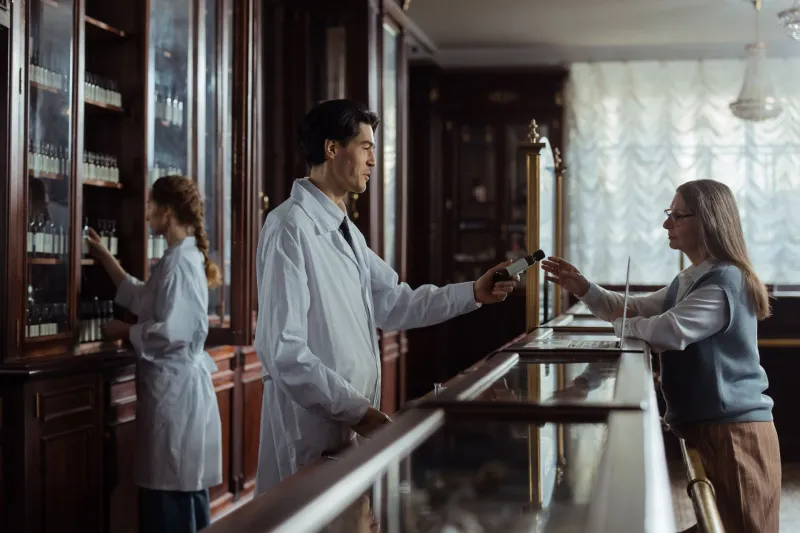
In Lithuania, for example, pharmacy students are required to complete structured practical training periods inside licensed pharmacies — not simulated dispensary labs, but actual operating establishments where real patients arrive with real prescriptions and real questions. These placements begin relatively early in the academic program and accumulate across multiple years. By the time a Lithuanian pharmacy graduate sits for licensure, they have typically logged hundreds of hours in direct patient-facing roles, learning to identify drug interactions in live context, counsel patients on chronic medication regimens, and collaborate with physicians in ways that go well beyond counting tablets.
The supervising pharmacists in these settings are not simply credentialing administrators. They function as mentors in the traditional sense — professionals who transmit institutional knowledge, clinical judgment, and the kind of situational awareness that no textbook reliably conveys. This relationship is embedded in the regulatory framework. It is not optional, and it is not abbreviated.
How American Training Drifted Away from the Dispensary
The United States once had a comparable tradition. For much of the twentieth century, pharmacy apprenticeships — formal preceptorships with licensed practitioners — were considered foundational to professional development. A pharmacist learned from another pharmacist, on the floor, under pressure, over time.
The transition to the PharmD as the sole entry-level credential, completed in the 1990s and early 2000s, was intended to elevate the profession. In many respects, it succeeded. American pharmacists today receive sophisticated training in pharmacokinetics, therapeutics, and pharmaceutical chemistry. The academic rigor of top pharmacy programs is not in question.
What eroded, however, was the sustained, relationship-based immersion in actual dispensary practice. Clinical rotations exist within PharmD programs — typically in the final year — but they are compressed, often rotated across multiple settings in short blocks, and increasingly conducted in institutional environments like hospitals rather than community pharmacies. The independent, neighborhood pharmacist who once served as a long-term preceptor has been largely displaced by large retail chains, where the operational model prioritizes throughput over mentorship.
A pharmacist working a drive-through window at a high-volume chain pharmacy is not positioned to transmit the kind of nuanced clinical wisdom that Eastern European apprenticeship models are specifically designed to cultivate. The incentive structures simply do not align.
The Patient Interaction Deficit
This structural divergence has measurable effects on patient care — effects that are easy to overlook precisely because they are defined by what doesn't happen.
In Baltic pharmacies, it remains common for a pharmacist to spend five to ten minutes with a patient discussing a new prescription — asking about concurrent medications, flagging potential contraindications, and adjusting counseling based on the patient's health history. This is not considered exceptional service. It is considered standard practice, shaped by training that emphasized patient interaction from the earliest stages of professional formation.
In the United States, a 2022 survey by the National Alliance of State Pharmacy Associations found that the average pharmacist-patient interaction at retail chains lasts under ninety seconds. That figure reflects not a failure of individual pharmacists, but a systemic outcome: professionals trained within a model that has deprioritized the relational dimensions of pharmaceutical care.
The consequences range from the mundane to the serious. Missed opportunities to identify drug-drug interactions. Patients who leave the counter without understanding how or when to take a medication correctly. Chronic conditions managed less effectively because no one in the patient's care team had the time — or the trained instinct — to ask the right questions.
What Policy Reform Might Look Like
Several pharmacy education reformers in the United States have pointed toward the Eastern European model as a reference point, though the conversation remains largely confined to academic circles.
Proposals under discussion include extending mandatory community pharmacy rotations within PharmD programs, creating formal preceptorship registries that incentivize independent pharmacies to accept long-term students, and establishing post-graduate apprenticeship tracks for pharmacists who wish to develop specializations in areas such as geriatric medication management or chronic disease counseling.
Some states have begun experimenting with expanded pharmacist scope-of-practice laws, allowing pharmacists to prescribe certain medications, administer vaccinations, and conduct basic health screenings. These initiatives are meaningful, but they address the authority side of the equation without fully resolving the training side. Granting pharmacists broader clinical responsibilities is most valuable when those pharmacists have been prepared, through sustained practical experience, to exercise that authority wisely.
The Lithuanian and Estonian models suggest that the answer is not simply more classroom hours or more advanced degrees. It is earlier, longer, and more structurally embedded exposure to the realities of dispensary practice — under the guidance of experienced professionals who are given the time and the institutional support to teach.
A Profession Worth Rebuilding
The pharmacist has always occupied a distinctive position in healthcare: accessible without an appointment, trained at a level of clinical depth that most patients underestimate, and positioned to catch errors that slip through the gaps between physician and patient. That potential has not disappeared from American pharmacy. It has simply been compressed by decades of structural choices that prioritized speed and scale over depth and relationship.
Eastern Europe did not stumble into a better model by accident. It preserved and formalized a tradition of mentored, dispensary-based learning that American pharmacy once shared — and then gradually abandoned in the pursuit of efficiency.
Restoring that tradition would require deliberate policy commitments, institutional investment, and a willingness to measure pharmacy education not only by what graduates know, but by what they can do when a patient is standing in front of them with a complex medication history and a question that no algorithm has yet learned to answer.