Before the Waiting Room: How Lithuania's Apklausa-First Pharmacy Culture Catches Illness Early—and Why America's Front Door Is a Parking Lot
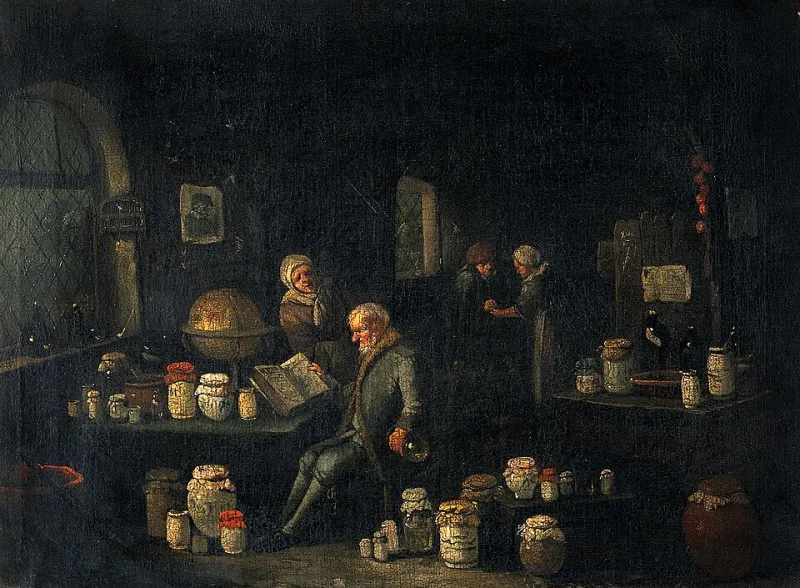
Photo: After Egbert van Heemskerck, Public domain, via Wikimedia Commons
Walk into any apšvietas-filled pharmacy in Vilnius or Kaunas on a Tuesday morning and you will likely find something unfamiliar to American eyes: a pharmacist conducting an unhurried conversation with a patient who has no prescription, no appointment, and no intention of seeing a doctor that day. The pharmacist may take a blood pressure reading, ask about symptom duration, recommend an OTC remedy, and—critically—tell the person to come back in 48 hours if things haven't improved.
This is not customer service. It is de facto primary care triage, and it is embedded in how Eastern Europeans use their health systems.
The Cultural Default
In Lithuania, as across much of Central and Eastern Europe, the pharmacy—vaistinė—is the default first stop for anything that doesn't feel like an emergency. A sore throat, a urinary complaint, a child's low-grade fever: the pharmacist evaluates, advises, and either resolves the issue or escalates. General practitioners are not gatekeepers in the same way they are in the US, but they are also not the first contact for minor complaints. The pharmacist is.
The result is a system where family doctors see fewer trivial cases, urgent care isn't clogged with ailments that never needed a physician, and problems that do warrant escalation arrive earlier in their course.
Why American Pharmacies Can't Do This—Yet
The structural obstacles in the US are not cultural; they are financial and legal.
First, reimbursement. A Lithuanian pharmacist performing a triage assessment is operating within a system that, increasingly, recognizes and in some cases pays for pharmaceutical care. An American pharmacist is paid almost exclusively by the script. Fifteen minutes of symptom evaluation earns nothing; a filled prescription earns margin. The incentive structure is unambiguous.
Second, workload. Chain pharmacy staffing models in the US leave pharmacists with minutes per patient, not the quarter-hour a proper triage conversation requires. You cannot assess a sick child while verifying insurance in a drive-through lane.
Third, liability and scope. While pharmacist scope has expanded in several states—prescribing for flu, strep testing, even some vaccinations—the default remains a narrow band of activity hemmed in by pharmacy board rules that vary wildly by state.
What It Would Take
Making the American pharmacy a genuine first stop would require three things happening in concert:
-
A reimbursed triage benefit. Medicare and commercial payers would need to compensate pharmacist consultations the way they compensate a nurse line—perhaps at a lower rate, but at something. The precedent exists: collaborative practice agreements and pharmacist-conducted immunizations were once radical too.
-
Referral infrastructure. A triage point is only useful if escalation works. Pharmacies need same-day referral pathways to clinics and telehealth, with documentation that actually reaches the receiving provider.
-
Staffing reform. No state legislature can legislate away a fifteen-minute wait to verify three prior authorizations. Chain staffing ratios would have to change, either voluntarily or through the kind of workplace regulation now being debated in several states.
None of this is exotic. Lithuania didn't invent pharmacy triage through legislation alone—it grew from a public that trusted the pharmacist and a system that gave the pharmacist time to be trustworthy. America has the pharmacists. It lacks the time, the payment, and the permission.
Until those arrive, the American pharmacy will remain what it has become: a highly efficient dispensing terminal with a clinician standing behind it, trained to catch the early signs of a serious illness, and given no realistic opportunity to look.